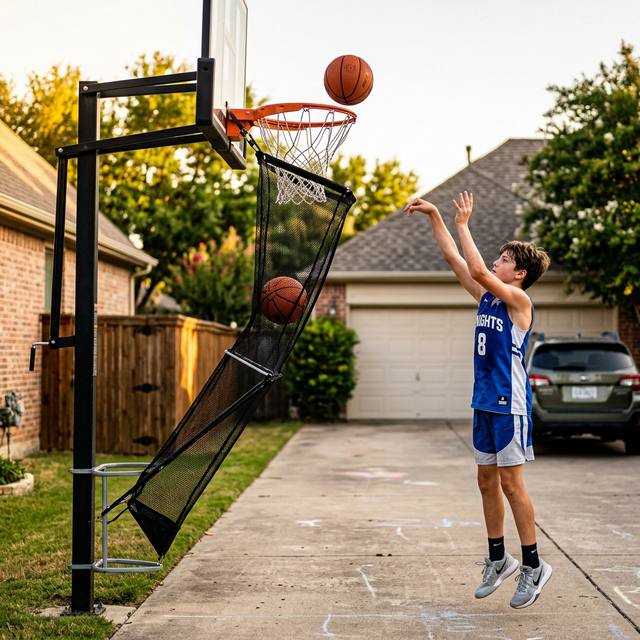
To stop a thumb flick in your basketball shot, you must isolate your shooting hand and reduce guide hand interference. The most effective methods include Tuck-Thumb shooting, the guide-hand “Quarter Trick,” and daily one-handed form shooting from close range. These adjustments prevent the guide hand from pushing or rotating the ball at release.
Executive Summary
A “thumb flick” occurs when a player uses the thumb of their non-shooting (guide) hand to help push the basketball during the release phase of a shot. While it can feel like a natural way to generate extra power—especially for younger players or those shooting from deep—it introduces side-to-side force that ruins shooting consistency. This guide outlines the mechanics behind the thumb flick, how to diagnose it using your phone, and the exact training progression required to eliminate it from your shooting pocket.
What is a Guide Hand Thumb Flick?
The guide hand’s sole purpose is to balance the basketball on your shooting hand until you reach your set point and begin your upward release. Once the release begins, the guide hand should peel away cleanly, leaving the shooting hand to propel the ball and generate clean backspin.
A thumb flick happens when the guide-hand thumb pushes forward or inward against the ball during the final release. This effectively turns a one-handed shot into a two-handed push, causing the ball to slide off-center.
Why Do Basketball Players Develop a Thumb Flick?
Most players develop a thumb flick early in their basketball career due to three common factors:
- Lack of Hand/Core Strength: Younger players often struggle to shoot the ball to a 10-foot rim using one hand. They naturally use the guide hand thumb to add pushing power.
- Improper Shot Pocket Placement: If you bring the ball up too far to the opposite side of your shooting eye, your guide hand is forced to stay on the ball longer to keep it balanced, resulting in a push.
- Early Release Timing: Pushing the ball before it reaches the peak of your jump or your shot set-point forces both hands to active engagement.
How Does a Thumb Flick Affect Your Shooting Accuracy?
When your guide hand thumb flicks the ball, it introduces a second force vector. Instead of the ball rolling straight back off your index and middle fingers, it receives a slight lateral push. This results in:
- Side-to-Side Misses: Pushing the ball left or right of the rim.
- Inconsistent Spin: Instead of clean, vertical backspin (which helps the ball bounce softly off the rim and drop in), the ball gets a diagonal or “flat” spin.
- Reduced Range: Pushing with the guide hand makes your shot flatter and reduces your natural arc.
How Do You Test and Diagnose a Thumb Flick?
Before trying to fix your shot, you need to verify if and how much your thumb is interfering.
- The Phone Camera Test: Set up your smartphone on a tripod or have a partner record you from your shooting hand side, angled slightly from the front. Record 10 shots in slow motion (120 or 240 FPS).
- The Rotation Check: Look closely at the spin of the ball. If the black lines of the basketball are spinning diagonally or sideways rather than vertically, your guide hand is pushing the ball.
- The Follow-Through Check: Watch your guide hand at the moment of release. If your guide hand palm ends up facing the basket or your thumb is pointing down or forward, you are flicking. A clean guide hand should remain open, with the palm facing inward or slightly back toward you.
Drill 1: The Tuck-Thumb Technique
The quickest mechanical fix to prevent the thumb from pushing the ball is to physically lock it out of the shot.
- How to do it: Press your guide hand thumb firmly against the side of your index finger before you pick up the ball.
- Why it works: By tucking the thumb, you disable the muscle group that performs the flicking motion. Start by taking 50 practice shots from 5 feet away with the thumb tucked.
Drill 2: The Guide-Hand “Quarter Trick”
This is a classic, low-tech training hack used by shooting coaches worldwide to provide instant tactile feedback.
- How to do it: Place a quarter or nickel between the thumb and the base of the index finger on your guide hand. You must squeeze the coin just enough to keep it from falling.
- Why it works: If you flick your thumb during the shot, your thumb will open up, and the coin will drop to the floor. Your goal is to shoot 20 shots in a row without dropping the coin. If the coin drops, the shot doesn’t count.
Drill 3: One-Handed Form Shooting
This drill strips away the guide hand entirely, forcing your shooting hand to take full responsibility for balance, trajectory, and release.
- How to do it: Stand 3 to 4 feet away from the basket. Hold your guide hand behind your back. Balance the ball on your shooting hand, raise it to your set point, and shoot.
- Why it works: Without the guide hand, your body is forced to align properly under the ball. If the ball falls off your hand, your hand placement is incorrect. Practice this until you can swish 10 in a row from three different spots close to the rim.
Do Any NBA Players Shoot with a Thumb Flick?
Yes. Some elite shooters, most notably Kyrie Irving and Stephen Curry, have a slight guide-hand thumb action on deep shots. However, their mechanics are highly refined over millions of repetitions, and they possess exceptional finger strength that allows them to maintain clean backspin. For developmental players and amateur shooters, eliminating the thumb flick remains the most reliable path to shooting consistency.
FAQ Section
Is a thumb flick always bad?
Not always, but it is highly inconsistent. If your shots are missing left and right, or your ball has lateral spin, the thumb flick is the likely culprit and should be fixed.
How long does it take to fix a thumb flick?
It typically takes 3 to 4 weeks of daily, focused practice (around 150-200 form shots per day) to overwrite the muscle memory and build a clean release.
Should my guide hand touch the ball at all?
Yes. The guide hand should touch the ball to keep it stable on your shooting hand during the gather and upward sweep. However, it should stop contact just before the final flick of your shooting wrist.
Why does my shot feel weaker after tucking my thumb?
You are losing the “push” force from your non-shooting hand. You will need to compensate by utilizing your legs more and improving the transfer of energy from your lower body into your release.
Can I use a shooting glove to fix this?
Some training gloves are designed to keep the guide hand fingers open, but simple hacks like the Quarter Trick or Tuck-Thumb are generally more effective because they build natural muscle memory without relying on external gear.
Actionable Conclusion
To eliminate your thumb flick, begin your next workout with 10 minutes of one-handed form shooting from 4 feet away. Once your shooting hand is locked in, introduce your guide hand using the Quarter Trick for 50 shots. Track your progress weekly using slow-motion video. By building a quiet, passive guide hand, you will see a dramatic improvement in your straight-line accuracy and shot rotation.
How we evaluate: We combine hands-on use (when available), manufacturer documentation, independent user feedback, and parent-focused criteria like safety, durability, ease of use, and long-term value.
Accuracy note: Pricing and product availability can change. Verify details on the retailer site before purchase.
Affiliate Disclosure: Sports Gadget Review is a participant in the Amazon Services LLC Associates Program. When you purchase through links on this page, we may earn a commission at no extra cost to you. Editorial recommendations are made independently.