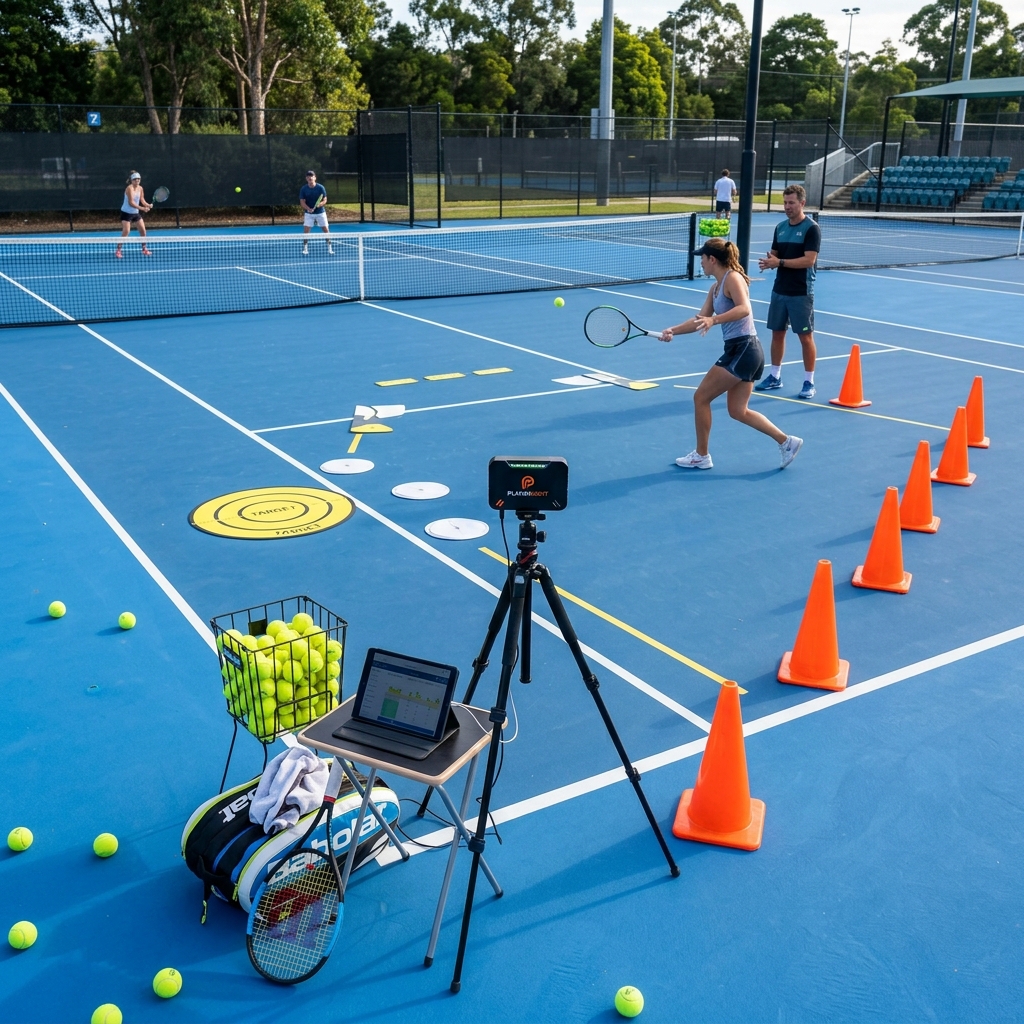
Tennis improvement is largely a repetition game, and the right gadgets can multiply the quality and quantity of your practice reps. Here are the best tennis training tools that actually make a difference.
Quick Picks
| Device | Best For | Price Range |
|---|---|---|
| Slinger Bag | Solo ball machine practice | $$$ |
| PlaySight SmartCourt | Swing analytics | $$$$ |
| Pocket Radar Ball Coach | Serve speed | $$ |
| Tourna Hit Tennis Trainer | Solo hitting rebounder | $ |
1. Slinger Bag, Best Portable Ball Machine
The Slinger Bag is a collapsible ball machine that fits in a bag. Feed rate, speed, and spin are adjustable, and it runs 2-3 hours per charge. Perfect for drilling groundstrokes alone.
Best for: Players who want machine-quality reps without the $2,000 price tag
2. Pocket Radar Ball Coach, Serve Speed Radar
Clip it to the fence behind the baseline and get instant serve speed readouts on your phone. No assistant required. Accurate to ±1 mph.
3. Tourna Hit Tennis Trainer, Solo Rebounding Net
A self-anchored hitting trainer with elastic cord return. Cheap, effective, and requires zero court time, practice in your driveway.
4. Stringview Court Sense, Shot Placement Tracker
Mounts to the fence and uses AI to track where your shots land. Gives you patterns on groundstroke accuracy, cross-court vs. down-the-line ratios.
FAQs
What age is appropriate for swing analysis tools? Most are useful from age 10+, once basic form is established.
Do I need a WiFi connection on the court? Pocket Radar works offline. Most AI cameras need hotspot or court WiFi.
Are ball machines worth it for juniors? Yes, consistent feeding builds muscle memory faster than irregular human feeding.
How to Build a Solo Tennis Training Routine
Most junior tennis players only improve during group lessons or match play, but players who supplement with daily solo training pull ahead quickly. A structured home routine beats irregular “just hitting” every time.
Daily (20 min):
- 100 reps against a Tourna Hit trainer or wall, focusing on footwork split step before each contact
- 50 serve reps from each side, track speed with Pocket Radar weekly
Weekly (1 session):
- Ball machine session targeting specific patterns: crosscourt forehand, down-the-line backhand, approach shot to net finish
Buying Guide: What Actually Matters by Age
Ages 7–10 (beginners): A simple rebounder and low-compression foam balls for rallying practice. Technology is secondary to building touch and enjoyment.
Ages 11–14 (developing): A serve speed radar (Pocket Radar) tracks progress and creates motivation. A ball machine makes solo drilling productive.
Ages 15+ (competitive): Video analysis via a court-side camera. Swing data tools like Stringview Court Sense identify tactical patterns.
Court vs. driveway requirements: Pocket Radar and wall rebounders work anywhere. Ball machines require a court. Video cameras work in both settings.
Understanding Tennis Training Data
Serve speed: Beginning juniors average 40–55 mph. Competitive 14-year-olds typically reach 70–85 mph. Elite juniors can touch 100+ mph by 16–17. Monthly trends matter more than raw numbers.
Shot placement accuracy: A useful benchmark is 14 of 20 balls landing within 3 feet of a target zone, solid directional control for a youth player.
Best Upgrade Path for Serious Junior Players
Start with: rebounder + serve speed radar
Add: ball machine once technique is solid
Add: video analysis once competing in tournaments and identifying tactical gaps
Add: court GPS or positioning camera for advanced shot pattern analysis
Additional Products Worth Considering
Pressurized ball hopper, collecting balls after machine sessions is tedious without a hopper. A 50-ball hopper ($25–40) saves significant time. Check Price →
Agility ladder, short-recovery footwork is the #1 on-court athleticism gap for junior players. 15 minutes of ladder work 3x weekly produces measurable footwork improvement in 4–6 weeks. Check Price →
Resistance band shoulder rotations, shoulder health is critical for junior tennis players. 5 minutes of external rotation band work before every practice prevents the rotator cuff issues that often appear at ages 14–16.
FAQs, Extended
What do tennis academies use that home players don’t? Elite academies use Hawk-Eye or PlaySight court systems, $50,000+ fixed camera arrays that track every ball and player automatically. The Pocket Radar and court camera get you 70–80% of useful data at 1% of the price.
Is a ball machine worth it for a 10-year-old? Yes, if your player practices 4+ days per week. For players training 1–2 days per week, a rebounder provides better value, simpler, cheaper, and more flexible for driveway use.
What’s the most important tennis skill to develop at ages 8–12? Footwork. Every elite tennis coach agrees: technical stroke improvements are limited when footwork is inadequate. Cone drills, agility ladders, and split-step training before any ball-striking work pays compounding dividends.
Updated: March 2026, Sports Gadget Review Team
Related Articles
- Best Golf Launch Monitors for Home Practice
- Best Youth Pickleball Gear
- Best Golf Launch Monitors for Home Practice
- Best Youth Pickleball Gear
We evaluate sports gear and fitness products independently. To learn more about our editorial standards, read our Editorial Policy.
How we evaluate: We combine hands-on use (when available), manufacturer documentation, independent user feedback, and parent-focused criteria like safety, durability, ease of use, and long-term value.
Accuracy note: Pricing and product availability can change. Verify details on the retailer site before purchase.
Affiliate Disclosure: Sports Gadget Review is a participant in the Amazon Services LLC Associates Program. When you purchase through links on this page, we may earn a commission at no extra cost to you. Editorial recommendations are made independently.